
The Need for A Renewed Course in Miracles
Given how A Course in Miracles (ACIM) came into being – dictated word for word by one who has achieved full realization as a human being and who embodies the ultimate destiny of humanity, and faithfully written down and then typed out over the course of seven years, with additional edits over the years immediately following – it would seem that the Course is close to being a perfect teaching, a new “song of God” for modern humanity, and that no additional revision of it would be necessary. So why has A Renewed Course in Miracles (ARCIM) been created?
As far as the Course being a nearly perfect teaching, the coming into being of ACIM, from the perspective of process, was far from “perfect.” The scribe of the original material, Helen Schucman, ended up having significant issues with the entire project. It is related that Helen at first felt quite resentful at the demands on her personal life, both inner and outer, that her “assignment” as part of the ACIM project required of her. As a result, she expressed considerable resistance to the writing process of the Course, particularly at the beginning of the project. A part of the original teaching from Jesus was directed toward these personal issues, and to Helen’s at times contentious professional relationship – not related to the Course – with project co-collaborator Bill Thetford.
This didn’t mean that the essence of the Course intended for general readership became distorted or diluted due to the challenges of the process. Helen’s personal issues and her and Bill’s relationship were ideal microcosms for the principles of the Course to be applied to as it was scribed, typed out, studied and practiced. In fact, the process of the Course coming into being was set into motion in the spring of 1965 as a result of Helen and Bill acknowledging to each other that their professional relationship was dysfunctional and needed help. But the resistance by Helen to the entire project especially at the beginning meant that what was able to “come through” from Jesus was definitely impacted, that is, at least in how it was able to come through.
This issue of Helen’s resistance to the writing process was directly addressed by Jesus to Helen as recorded in her Notes: “As long as you [Helen] take accurate notes, every word is meaningful. But I [Jesus] can’t always get through [to you, Helen]. Whenever possible, I will correct retroactively. Be sure to note all later corrections. They mean that you are more receptive than you were when I tried before.” This “interference” in Helen being able to clearly “hear” Jesus in his dictation of the material to her seems to have cleared up around the middle of Text Chapter 5.
The original Course wasn’t “perfect” with regard to content as well as process in that it underwent several edits by the time it became publicly available. For instance, the originally published and best known version of A Course in Miracles – the Foundation for Inner Peace (FIP) version – significantly reformulated the early chapters of the Text and in so doing discarded what some feel was important material related to the psychological foundation of miracles. This meant that what was published as the FIP version of ACIM was different in some ways, though not in essence, than the original material received from Jesus.
Currently there are four versions of the entire original ACIM available (one of them in two different editions):
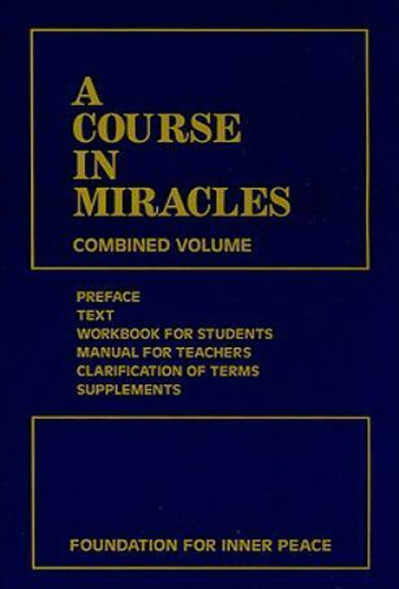
The Foundation for Inner Peace version
This is the original published version, the one most people who have read or studied the Course are familiar with, and was the only version available to the public until after the year 2000.
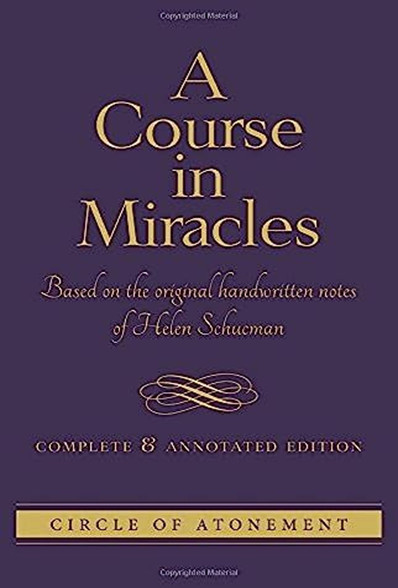
The Circle of Atonement "Annotated NOTES" version
A Course in Miracles: Based on the original handwritten notes of Helen Schucman—Complete & Annotated Edition.
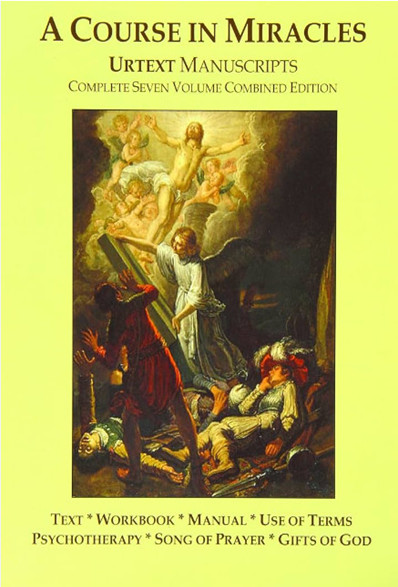
The "URTEXT Manuscripts" version
A Course In Miracles Urtext Manu-scripts—Complete Seven Volume Combined Edition.
Fourth Version (two different editions)
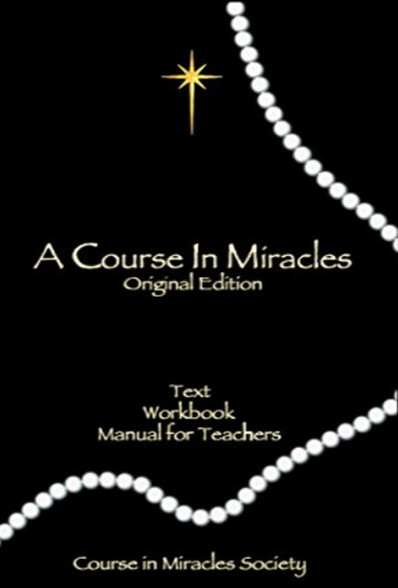
The "Original" Edition
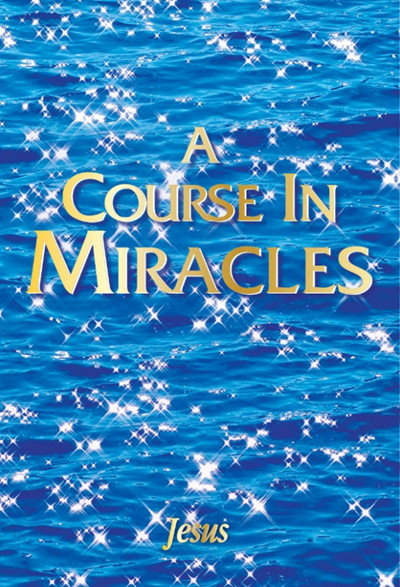
The "SPARKLY" Edition
The Text-only part of this fourth version
is known as the “HLC” (Hugh Lynn Cayce) version.
Of these four versions of the complete original ACIM, only the “Urtext Manuscripts” version isn’t revised from the original unedited material. It presents the Course more or less word for word as the material appears in the original Notes and Urtext. Paradoxically, as accurate as this version is to the original material through not being revised in any way, it is in a sense a violation of Jesus’ mandate regarding what was to be made available to the general public of the original Course material, as discussed in the “How A Course in Miracles Came Into Being” section located within the “About” menu of this website. Specifically, the personal references to Helen and Bill not applicable to every human being have been left in this version in order to provide the reader as faithful a version of the original Course material as possible. All original versions except the “Urtext Manuscripts” version follow Jesus’ mandate of removing personal references to Helen and Bill, which indicates that the version of the Course to be made publicly available had to be a revised version of the Course from its original form dictated to Helen and typed out by Bill.
Finally regarding all versions of the original A Course in Miracles, in the source material, i.e., in the Notes and Urtext, none of the paragraph, section or chapter breaks were given by Jesus, nor were the section or chapter titles of the Text. In all versions of the original Course currently available, these breaks and titles were determined by the editors, and accordingly there are minor differences between the versions in what sentences make up various paragraphs, sections, and chapters, while there are many differences in the Text section and chapter titles across the versions. (See the Course Versions Cross-Reference accessible in the “Study Materials” menu of this website for a detailed exploration of these differences.)
In summary, in so far as the idea of a perfect original version of the Course goes, such a version has never existed. But that fact in itself wasn’t a determining factor in the bringing forth of a renewed version of the Course at this time. Other important considerations are what led to the presentation of A Renewed Course in Miracles.
The first of these considerations is that in the half century since the Course came into being, major changes have taken place in the way U.S. English – the language in which the Course came to the world – is used by many of its users in the 21st century. The unconscious gender biases present in U.S. English general usage through the 20th century, such as the use of the noun “man” and pronoun “he” as representative of all human beings, are no longer acceptable to many participants in the language. Over the ensuing decades of U.S. English usage since the original ACIM was completed, new gender-neutral forms of language usage have been developed and accepted as appropriate, and in some cases as new alternative standard usage. During these years, the old use of gender-biased language has become dissonant for many readers, making material written in such language difficult to read, accept, and embrace, especially as representative of a new way of relating to the world. A renewed version of the Course with gender-neutral language opens this essential teaching to many readers who are ready to receive its message in a language friendly to their sensibilities.
The use of traditional Christian terminology in the original Course, terminology that also has an intense gender-biased quality to it, has also become difficult for many seekers of universal truth to accept in a new century and millennium, and such terminology may also present challenges for those of other faiths worldwide who otherwise would be very interested in the teaching of the Course. The terms “Father” for the Creator, “Son” and “Sonship” for the Creator’s perfect Creation, and “He,” “Him,” etc. as pronouns for the Holy Spirit are examples of the gender-biased nature of traditional Christian terminology and the thought that stands behind it. These and other related terms in the original Course material are difficult for many seekers of truth in our time given the historical connotations behind such terminology. A version of the Course with such terminology rendered into universal spiritual language opens the teaching of the Course to new students of various faiths and spiritual understandings and those of a more universal Christian faith who may struggle with the limited spiritual perspective that traditional Christianity has come to represent in world culture.
Because the Course was written in collaboration with two members of academia, a subtle bias is present in some of the language in the original versions that assumes a certain level of academic knowledge, for instance in a sentence such as, “It [the Course] is a required course.” Those who have attended university of course know what this term means, but others may not. This bias may present challenges for some readers of the Course who have not been trained academically, and though this bias is minor, it is worth noting.
An additional aspect of this issue is that the original Course is often worded to address co-collaborators Helen and Bill as a pair and as the original recipients of the teaching – in their relationship with each other and with their fellow human beings, with Jesus, with the Holy Spirit, and with the Divine – rather than addressing itself in these instances to a general universal reader. This is seen in the extensive use of the pronoun “yourselves” (Helen and Bill) in the original material rather than “yourself” (the individual reader), and also in the wording of many passages with Helen’s and Bill’s particular learning challenges as the focus, instead of wording the same teaching without assuming that the general reader will share Helen’s and Bill’s particular learning challenges.
Finally, the original Course itself invites renderings that will make its message come alive for human beings everywhere who have not yet felt stirred by its message due to the presentations that have been available so far. The original Course directly says that it is one of thousands of versions of the universal curriculum in awakening to Reality. How appropriate it is, then, that the language of the original A Course in Miracles be made new and fresh for new generations of readers, students, and teachers.
Accordingly, A Renewed Course in Miracles transforms all language use from the original material that may have become a block to readability for all those seeking the truth of its teaching in our time and with our current language sensibilities. Half a century after humanity received the gift of this teaching, the entire original Course has been gone through carefully multiple times: word by word, phrase by phrase, sentence by sentence, and paragraph by paragraph, in collaboration with the original author. In this process all of the Course’s words have been lovingly lifted into the hands of their author and placed gently into form again, with the clearing of language usage and the renewal of the clarity of meaning that this process offers.
All gender-biased language has been transformed into gender-neutral language. Traditional Christian terminology (such as the all-male Christian trinity) has been transformed into universal spiritual terminology accessible to people of any faith or spiritual understanding. When possible, statements that assume a certain level of academic understanding have been clarified so that the meaning is evident to all readers, and language worded to address Helen and Bill as recipients of the teaching with their particular learning challenges has been revised to address anyone with the basic learning challenges we all face. As appropriate to increase clarity, negative statements (such as Jesus affirming “I am not absent to anyone in any situation”) have been transformed into positive statements (“I am available to everyone in every situation”).
In addition, statements in ACIM that may be true for some readers and students and not for others have been transformed in ARCIM to be true for all readers and students at all times, so that the teaching is true no matter what perspective it is considered from. For instance, the Workbook lesson theme, “I do not perceive my own best interests,” may be true for some readers or students and even for many at least some of the time, but other readers or students may have reached a level of development where they do perceive their own best interests, even if only part of the time. (One would hope that through becoming miracle-minded this would certainly be the case!) In order to render this statement true for all readers and students at all times, it has been transformed in ARCIM to: “When I misperceive, I do not recognize my own best interests.” This statement is always true. The Workbook lesson theme, “There is no death; the Children of the Divine are free,” while true on an absolute level, may be too much of a stretch for a reader or student to accept as true in their own personal experience. Like Prince Gautama, most of us do experience death around us continually on multiple levels. Thus to render this statement true even in our everyday experience it is transformed to read, “There is only Life and no death in Truth. The Children of the Divine are free.” The Workbook lesson theme, “There is nothing to fear,” likewise may not ring true in the experience of many readers and students. Many of us experience a great many things that we believe reasonably justify fear until we have advanced in our development past believing in such illusions. Thus this statement in ARCIM reads, “When I fully trust Reality, I know that there is nothing to fear.” These are examples of language transformation in ARCIM to render the teaching as true as possible in the experience of every reader and student.
A Renewed Course in Miracles also makes an essential distinction in language to clarify when old perception – that is, the way our eyes have been trained from birth to perceive a physical world of objects, forms and appearances outside of us as we normally do – is meant in a passage, and when new perception – that is, true or real vision, seeing beyond the form and appearance to the essence of things – is intended. In order to make this distinction between these completely different ways or “levels” of perception, the following verbs are used:
- The verb “look” or compound verb “look upon” or some variant is used whenever old perception, perception in the world of illusions, is meant, that is, the way we normally perceive the world around us through the body’s eyes and other senses.
- The verbs “see” or “behold” are used whenever new perception, called true perception or vision in the Course, is meant, that is, perceiving the essence of things with what the Course calls our “spiritual eye.”
- The verb “perceive” is used in passages where the meaning of perception in the passage is neutral and can become either old perception (looking) or new perception (seeing) according to our choice of how to perceive in the situation.
The meaning of countless passages in the Course becomes much clearer when these activities or levels of perception are distinguished in this way.
A Renewed Course in Miracles considers carefully the meaning of each word, phrase, sentence, and passage of the Course to render their meaning in as clear a presentation as possible for today, under the direction of their original author. The core intention behind every part of this new version is for total clarity of the meaning of the material. A half century after the Course was received by humanity, and so much nearer to the end of time promised by the Course, the Course’s author has indicated that there simply is no reason for any ambiguity to exist in this new “song of God.”
It is understood that A Renewed Course in Miracles will not appeal to every person interested in the Course. Many readers, students, and teachers of the Course are perfectly content with the Foundation for Inner Peace version of the complete original material; some may dislike and even oppose a new presentation of the material they hold so dear. Others are delighted with the new editions of the original words of ACIM that have become available—editions that capture the complete Notes and the Urtext content of the Course. At the same time, some old friends of the Course may find in the renewed version fresh perspective and understanding of concepts they may have long pondered the meaning of. And some new friends will find their entry into this essential teaching of awakening through A Renewed Course in Miracles.
If this new version of the Course reaches and speaks to any reader who has not yet had “sparks of light” ignited by the message of its author, it will have accomplished its purpose, which is at one with the ultimate purpose of the Course:
“If a sufficient number of people become truly miracle-minded quickly, the shortening process of completing the Atonement in time [to bring about the end of illusions] can be almost immeasurable.”